

The 3-Tool Rule
You don't need 15 AI tools. You need three.

Every week there’s a new “best AI tools” thread with 30+ recommendations. You bookmark them all, sign up for free trials, spend hours testing, and end up using none of them well.
You don’t need 15 AI tools. You need three. One for thinking, one for creating, and one for operating. Pick one per category, learn it deeply, and ignore everything else until you’ve outgrown it.
The 3-Tool Rule
Last week you mapped where AI fits in your business. Now you need to pick the right tools for the job.
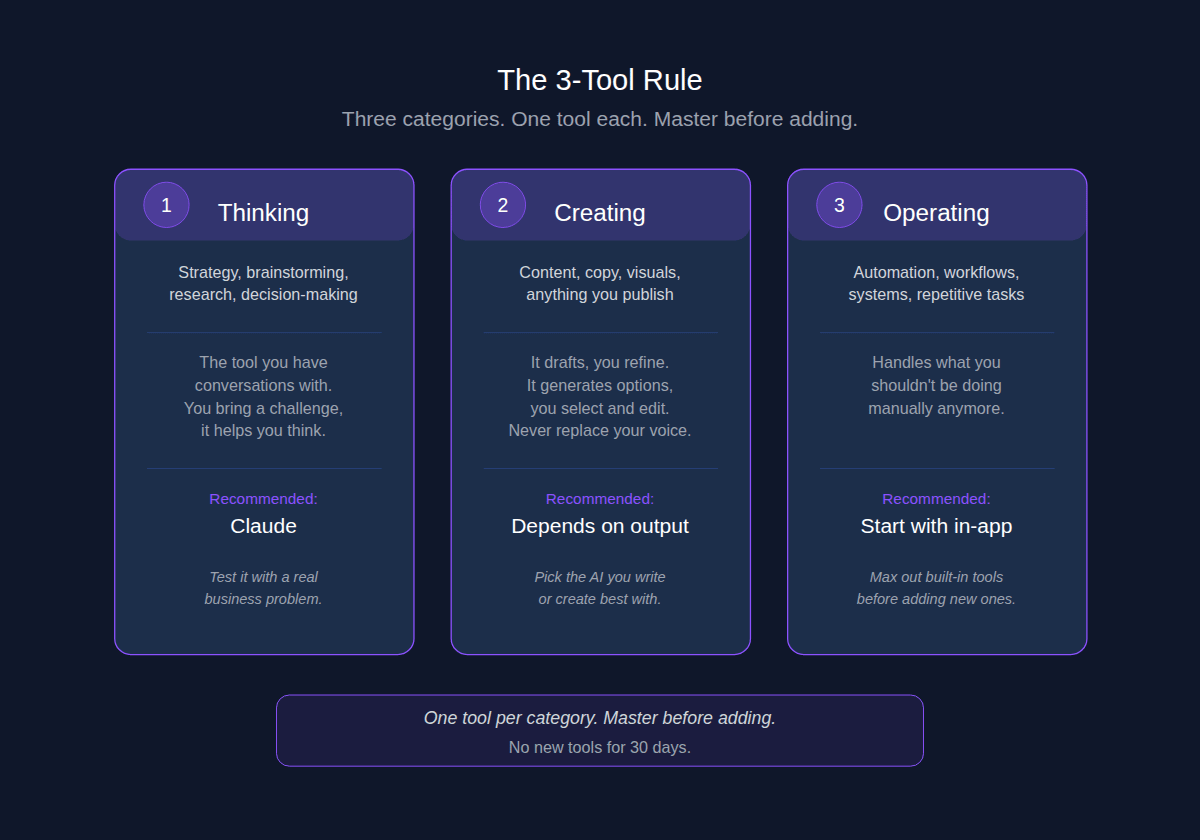
1. A Thinking Tool. For strategy, brainstorming, research, and decision-making. This is the tool you have conversations with. You bring it a challenge, it helps you think through it. My recommendation: Claude. It’s the most powerful option right now for deep thinking and structured reasoning.
2. A Creating Tool. For content, copy, visuals, and anything you publish. It drafts, you refine. It generates options, you select and edit. It should never replace your voice. If 80% of your output is written, pick the AI you write best with. If visual content is a big part of your workflow, pair your writing tool with a dedicated media tool.
3. An Operating Tool. For automation, workflows, and repetitive processes. Start with in-app automations first. The tools you already use have built-in automation features that require no learning curve. Don’t jump to a separate platform until you’ve maxed out what’s already built into your existing tools.
The rule: One tool per category. Master it before adding another. If you can’t explain what each of your three tools does for your business in one sentence, you either have too many or you haven’t learned them well enough.
How this works in practice
AI for me is an enhancing tool for my thoughts. I’m not always in deep thinking mode, so I trained AI to get me there. Every idea starts in my mind, then I take it to AI and make it challenge me. Not the other way around. AI doesn’t generate my ideas. It stress-tests them.
One of the biggest wins was eliminating the blank page problem. I always have ideas, but I don’t always have the right structure in mind. I trained AI to help me organize and structure my thinking so I can move from concept to execution faster. The ideas are mine. The architecture is collaborative.
For operations, there are tasks I used to delegate to freelancers. Formatting, simple design work, basic writing tasks. Now my AI subscription handles those. Not because AI is better than a skilled freelancer, but because for routine tasks at my current stage, it’s faster and more cost-efficient.
The opportunities are limitless. But I only do what I need now, because it’s not about adding more. It’s about reduction and protection of focus on what is only necessary.
Define your 3-tool stack this week. Write one sentence for each:
→ Thinking tool: Which AI will you use for strategy, brainstorming, and research?
→ Creating tool: Which AI will you use for the content you produce most?
→ Operating tool: What are you still doing manually that you shouldn’t be?
For each one, finish this sentence: “I use [tool] for [purpose] because [reason].”
If you can’t finish that sentence clearly, you either haven’t chosen yet or you haven’t gone deep enough.
Then commit to one rule for the next 30 days: no new tools. Only deeper use of these three.
Talk Saturday.
Yassin