

The AI Fit Map
Where AI creates real leverage in your business, and where it gets in the way.

Everyone tells you to use AI for everything. That’s terrible advice.
Without business clarity first, AI becomes a multiplier of confusion. You automate the wrong messaging. You generate content for the wrong audience. You build workflows around a business model that isn’t validated.
The AI conversation right now is all hype and no filter. Every thread says “use AI for everything.” Every tool promises to replace half your workload. So founders try to do exactly that. They automate things they don’t even understand manually yet. They throw vague requests at it and expect magic. They copy-paste outputs without reviewing them.
The result is that AI works against them. It makes them generic and produces the same flat output as everyone else using it the same lazy way.
Here’s the uncomfortable reality. AI is advancing at 50x while the majority of people are using maybe 10x of what it can actually do. The gap isn’t in the technology. It’s in the human operating it.
How to think about AI correctly
Think of AI as a super intelligent, adaptable, hard-working employee who just joined your company. They’re capable of incredible work, but they’re new. They don’t know your business, your audience, your standards, or your context. You need to train them. The more detailed, structured, and clear you are in that training, the better the outcome.
AI is a tool that aids you in problem solving. It is not a fully trustworthy, independent problem solver.
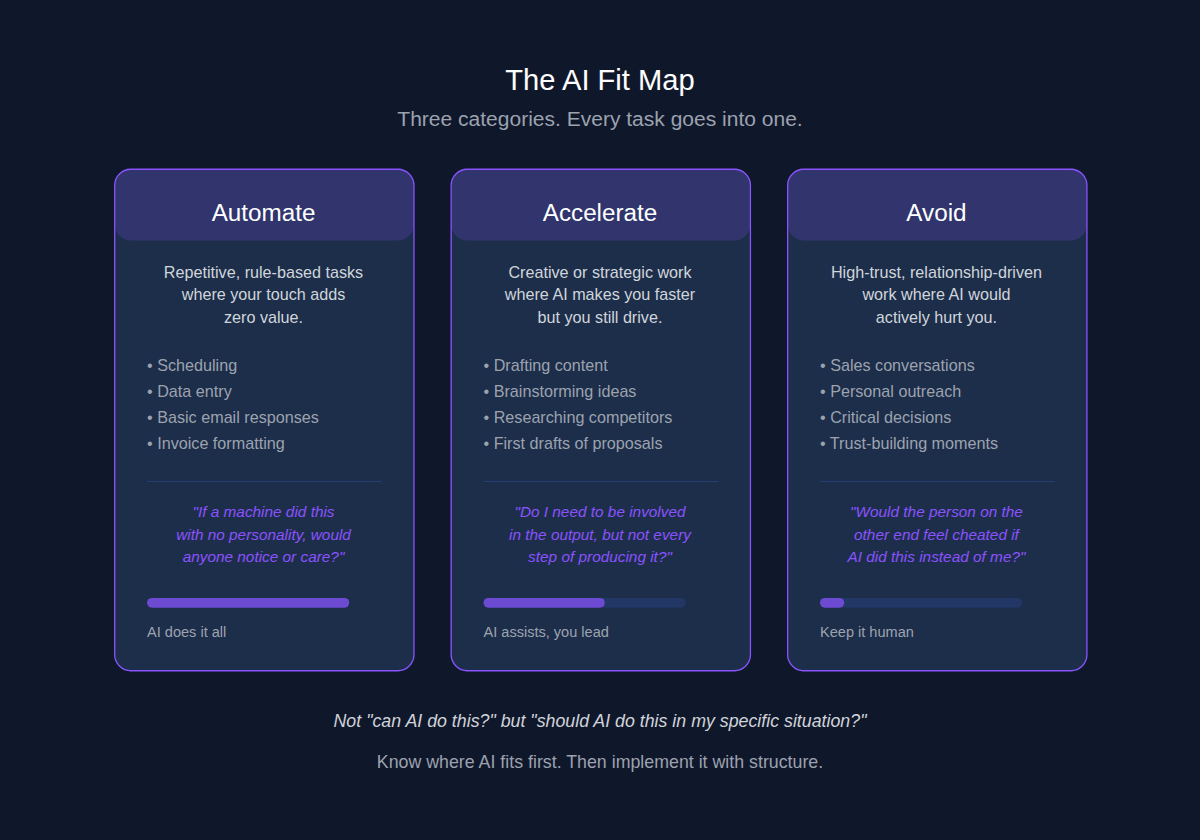
The AI Fit Map
Every task in your business goes into one of three categories.
Automate. Repetitive, rule-based tasks where your personal touch adds zero value. Scheduling, data entry, basic email responses, invoice formatting.
The filter question: “If a machine did this with no personality, would anyone notice or care?”
Accelerate. Creative or strategic work where AI makes you faster but you still drive. Drafting content you then rewrite in your voice, brainstorming ideas you then filter, researching competitors.
The filter question: “Do I need to be involved in the output, but not necessarily in every step of producing it?”
Avoid. High-trust, relationship-driven work where AI would actively hurt you. Sales conversations with early customers, personal outreach to your network, critical business decisions.
The filter question: “Would the person on the other end feel cheated if they knew AI did this instead of me?”
This week, list 5-10 tasks you do in your business. For each one, assign a category: Automate, Accelerate, or Avoid. Use the filter questions above.
Then pick one task from your Automate column and one from your Accelerate column. Set up AI to handle those two this week. Start small. Learn how to direct it well on simple tasks before you trust it with complex ones.
Talk Saturday.
Yassin