

The Founder's Operating System
Three simple components that keep everything else in this series running.

Clarity without a system is just good intentions.
You’ve defined your problem, your audience, your AI strategy, and your tools. But without a consistent structure for how you work, you’ll drown in chaos the moment things pick up. You’ll wake up Monday with no plan, work on whatever feels urgent, and end every week feeling busy while nothing compounds.
What a system actually looks like
I’ve had a Notion-based operating system for 3 years. I can’t tell you how many times I’ve adjusted it. Added sections, removed sections, restructured entire workflows. But what I can tell you is that it’s my second home. Everything lives there.
My setup uses only two tools: Notion for the main OS hub and Notion Calendar. That’s it. Inside Notion, I built a structure that fits how I actually work. Goals divided into annual and monthly. A to-do task system. A content OS where I manage ideas and content production. A prompt library for AI workflows. A full notes section divided by topic. It’s literally a system with everything in one place.
By having everything in one place, I’m never overwhelmed. Nothing gets lost. Nothing gets forgotten. No scavenger hunts through five different apps to find where I wrote something down.
A system doesn’t just organize your work. It buys back your time. And the time you buy back is where the real value is. That recovered time goes into deeper thinking, innovation, and the things that actually make you better.
The Founder’s Operating System
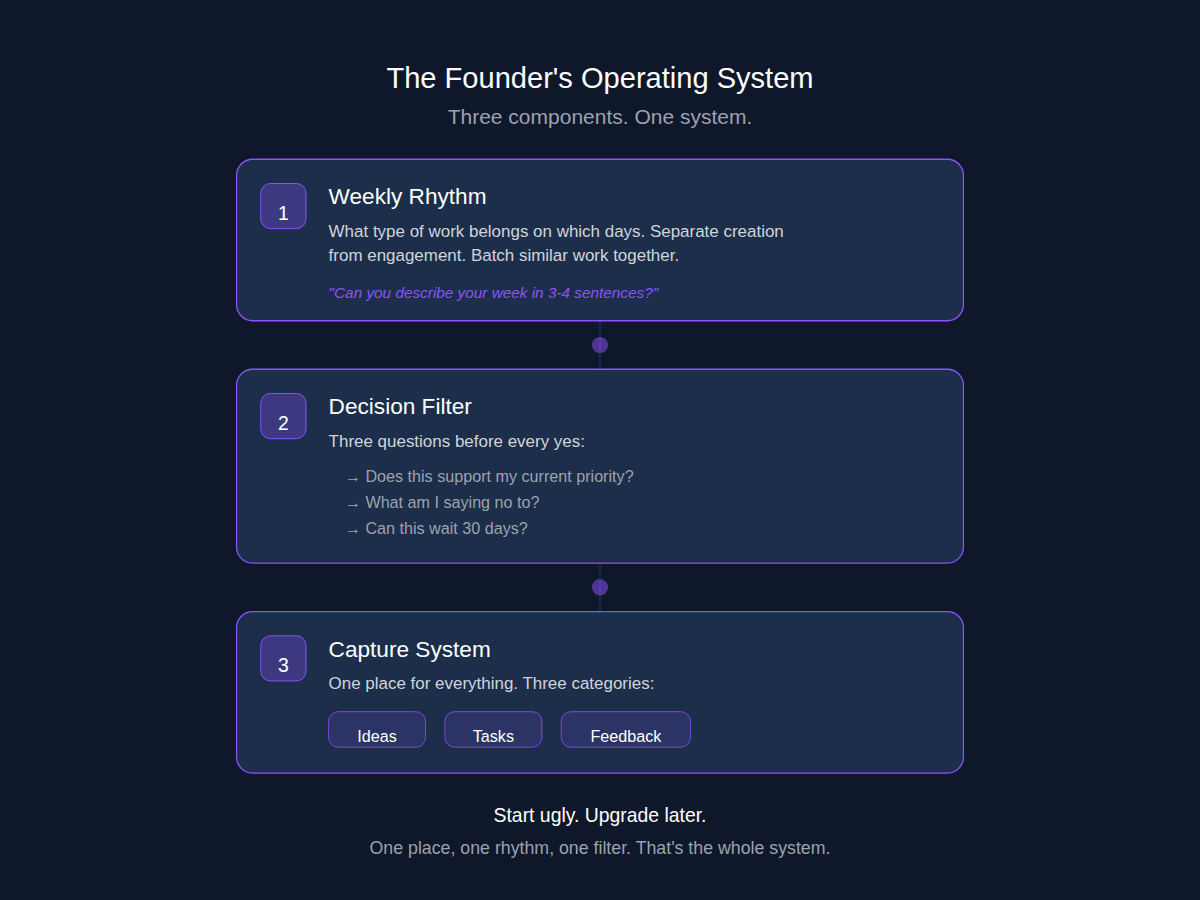
You don’t need my setup. You need three components.
1. A Weekly Rhythm. A simple map of what happens when. Not an hour-by-hour schedule. A block-level structure that tells you what type of work belongs on which days. Separate creation from engagement. Batch similar work together. Protect your highest-energy time for the hardest work.
The test: Can you describe your week in 3-4 sentences without checking a calendar? If not, your rhythm isn’t clear enough.
2. A Decision Filter. A set of questions you run every new opportunity, request, or idea through before you say yes. Three questions:
→ Does this directly support my current priority?
→ If I say yes to this, what am I saying no to?
→ Can this wait 30 days without consequence?
If it doesn’t support your priority, if saying yes means dropping something more important, or if it can wait, the answer is no. Or at least not now.
3. A Capture System. One place where every idea, task, piece of feedback, and commitment goes. Not five notebooks, three apps, and a pile of sticky notes. One system. Pick one tool. Create three categories: Ideas, Tasks, Feedback. Review it once a week.
Build your first operating system this week. Start with three things:
→ Your Weekly Rhythm: Write out what type of work belongs on which days. Can you describe your week in 3-4 sentences? If not, simplify until you can.
→ Your Decision Filter: Write down the three questions and put them somewhere you’ll see them daily. Run every new request through them for the next two weeks.
→ Your Capture System: Pick one tool. Create three categories: Ideas, Tasks, Feedback. One place. Review it once a week.
You don’t need Notion. You don’t need a fancy setup. You need one place that holds everything, a rhythm you can describe in a few sentences, and a filter that protects your focus.
Start ugly. Upgrade later.
That’s the full Founder Framework Series. Five weeks, five tools. Clarity, audience, AI strategy, AI stack, and now the system that keeps it all running. The foundation is set. Now build on it.
Talk Saturday.
Yassin