

The One-Person Filter
Target audience" might be the most overused and least useful concept in business. Here's what to do instead.

“Target audience” might be the most overused and least useful concept in business.
Founders define their audience as “entrepreneurs aged 25-35” and think they’ve done the work. They haven’t.
You cannot define a whole group of people because you’ll be lost in different character traits and preferences. But what you can do is focus on your ideal customer characteristics. This way you literally pinpoint and target their needs, fears, and passions associated with your offer.
When your audience is “everyone who might be interested,” you end up speaking to no one. Your landing page is vague. Your content is generic. Your offer tries to solve too many problems at once.
Most founders don’t realize this is the issue. They think the problem is their marketing, their design, or their pricing. But the root cause is almost always the same. They never defined who they’re actually talking to with enough specificity to make their decisions sharp.
The trap most founders fall into
Even founders who do the work often make a second mistake. They define their customer through their own lens. They describe the problem the way they see it, use language that makes sense to them, and assume their audience thinks the same way they do.
But the idea that feels perfect in your head might land completely differently on the other side. A technical founder building for non-technical users will instinctively describe their product in technical terms. A founder with deep industry experience will skip context that a newcomer needs.
The way you see your product is not the way your customer experiences it.
The One-Person Filter
The fix is simple. Stop thinking about audiences and start describing one specific person. Not a persona document with stock photos. A real human being you could describe to a stranger in 30 seconds.
Answer these five questions:
→ What’s their situation right now? Not demographics. What stage of life or business are they in? What decisions are they currently facing?
→ What have they already tried? What solutions have they attempted that didn’t work? This reveals their frustration and what they’re no longer willing to settle for.
→ What’s their biggest frustration right now? Not a category of pain. The specific thing they’d vent about to a friend over coffee.
→ What would “solved” look like to them? Their desired outcome in their own words, not your product features.
→ Where do they already spend time and attention? Which platforms, creators, or communities do they trust? This tells you exactly where to find them.
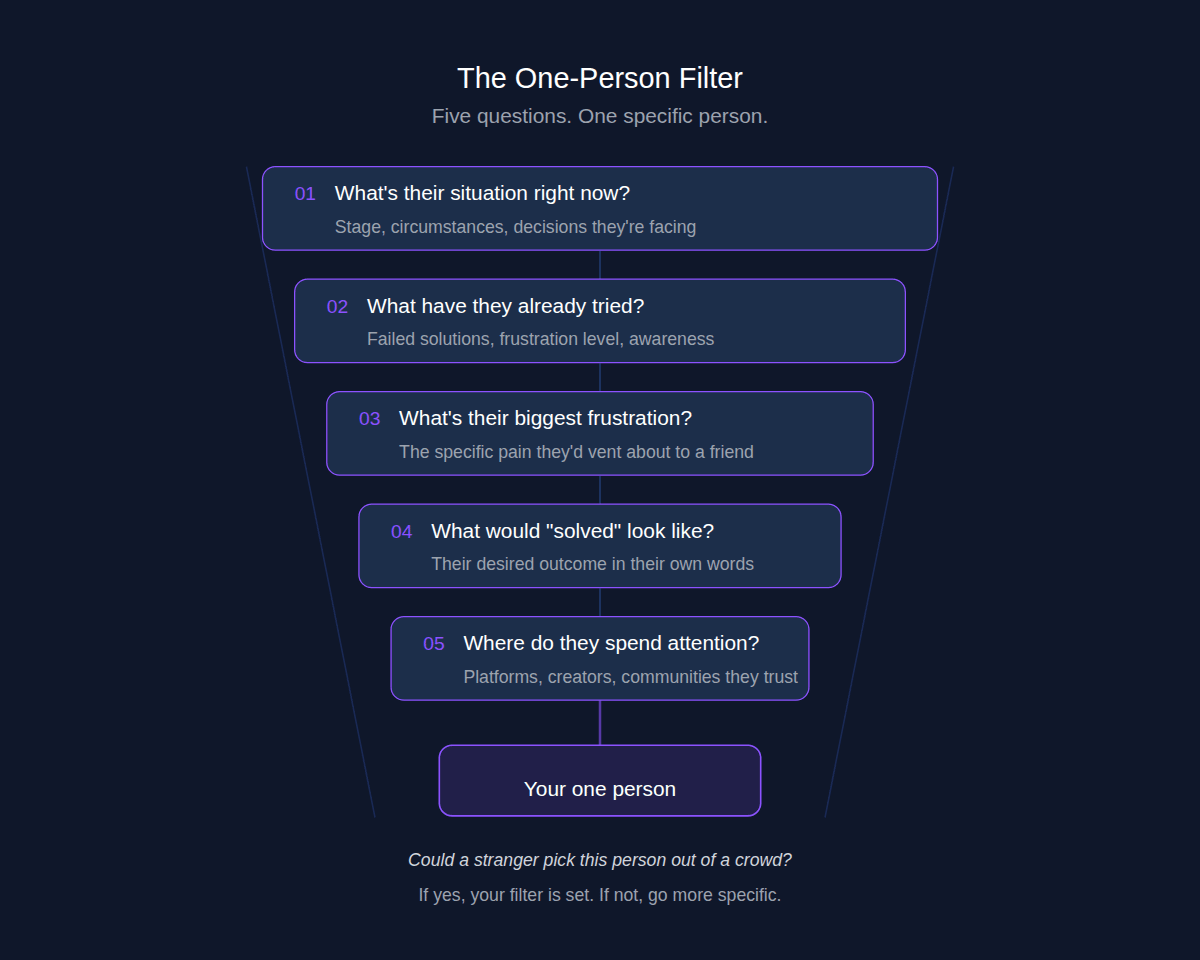
The test: Read your answers out loud. If someone listening could pick this person out of a crowd, you’re done. If they couldn’t, go more specific.
This week, answer those five questions about your one person. Then write a 3-4 sentence description of them as if you’re introducing them to a stranger.
Read it out loud. If someone listening could pick this person out of a crowd, your filter is set. If they couldn’t, go more specific.
Talk Saturday.
Yassin